
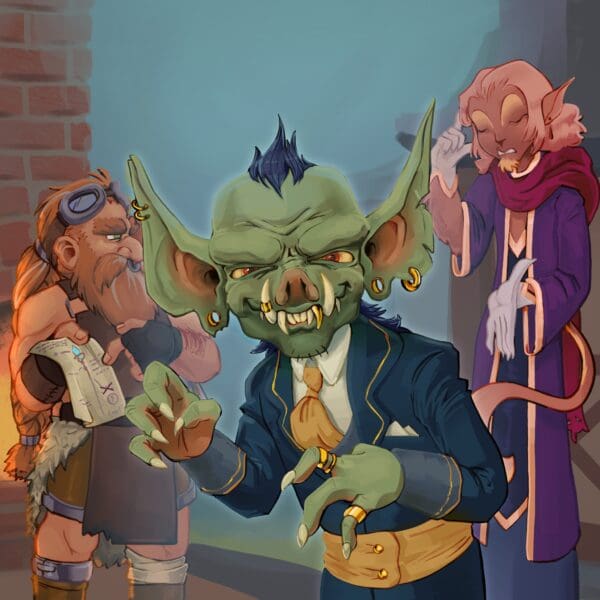
In the dark corners of many growing companies lurks a subtle but dangerous creature: the Expectations Goblin.
Unlike other monsters that attack with obvious chaos, the Expectations Goblin works quietly in the background, eroding the trust between leaders and team. He whispers assumptions into conversations, hides inside vague plans, and plants invisible agreements that no one actually made.
At first, everything seems fine. The team meets. The meeting ends. The team moves forward. Work begins.
But the goblin has already done its work. Someone believes a deadline was promised. Someone assumes a budget was approved. Someone thinks priorities were clear.
Yet none of it was explicitly agreed.
Weeks later, frustration erupts among leaders.
“I thought we were aligned.”
“Wasn’t that understood?”
“I assumed finance already approved that.”
By the time these phrases appear, the Expectations Goblin has already built his masterpiece.
As the saying goes: “Expectations are resentments under construction.”
And this goblin is the master architect.
Where the Expectations Goblin Hides Inside Growing Companies
The Expectations Goblin rarely appears in obvious ways. Instead, he hides in everyday leadership interactions where speed replaces clarity.
He thrives in places like:
- Strategy meetings where priorities are discussed but never confirmed
- Financial reviews where targets are mentioned but not explicitly agreed
- Leadership conversations that end with “I think we’re aligned”
- Budgets that are assumed to be approved rather than formally committed
- Informal hallway decisions that never make it into documented plans
In scaling companies, teams move quickly. Decisions are made. Everyone assumes the same understanding exists. But when expectations are left unspoken, every leader fills in the gaps differently.
That’s exactly where the Expectations Goblin lives.
How the Expectations Goblin Sabotages Growth
The Expectations Goblin thrives in ambiguity not deception. He appears whenever teams move too quickly past clarification and assume shared understanding.
He hides in places like:
- Vague strategy meetings
- Unclear financial targets
- Unconfirmed deadlines
- Half-discussed budgets
- Informal hallway decisions
- Lack of agreed accountability for outcomes
His favorite weapon is the phrase: “We’re aligned.” But alignment without verification is simply assumption wearing a suit.
When expectations remain unspoken, every person fills the gaps with their own interpretation. Sales hears one thing. Finance hears another. Operations assumes something entirely different.
The result?
Missed forecasts. Frustrated leadership. Finger-pointing across departments.
And most damaging of all: An erosion of trust.
How Unspoken Assumptions Create Leadership Friction
Unspoken expectations rarely cause problems immediately.
At first, teams move forward confidently, believing everyone understands the plan.
But over time, assumptions begin to diverge.
Sales interprets the target one way. Finance interprets the budget in a different way. Operations assumes something entirely different from both.
Weeks later, leaders begin discovering they were solving different problems all along.
Deadlines slip. Forecasts miss. Frustration grows.
And because no one can point to the moment where expectations were clearly defined, the result often becomes finger-pointing rather than progress.
That is how the Expectations Goblin slowly turns momentum into friction.
The Leadership Discipline That Forces the Goblin Into the Open
The Expectations Goblin survives on ambiguity.
The moment expectations are made explicit, his power disappears.
That’s why strong leadership teams rely on a simple but powerful discipline:
Confirming expectations before moving forward.
Instead of assuming alignment, leaders pause to verify it.
They ask questions like:
- What exactly are we committing to?
- Who owns the outcome?
- What does success look like?
- When will this be completed?
- How will we measure progress?
These questions may feel simple, but they transform assumptions into agreements.
And when expectations become explicit, the Goblin has nowhere left to hide.
The Level10 CFO Defense
The only way to defeat the Expectations Goblin is with two powerful tools that bring assumptions into the open and replace them with clarity:
Crucial Conversations and the Entrepreneurial Operating System (EOS).
Crucial Conversations create the environment where difficult but necessary discussions happen openly. Hidden assumptions are surfaced. Expectations are replaced with clear commitments.
EOS then provides the structure that keeps that clarity consistent across the organization.
The six components of the EOS model are designed to ensure alignment and agreement across the leadership team:
• Vision – Everyone understands the direction and priorities of the company.
• People – The right people are in the right roles with clear accountability.
• Data – Objective metrics replace assumptions and opinions.
• Issues – Problems are surfaced and solved instead of ignored.
• Process – The organization operates from documented and agreed systems.
• Traction – Teams execute with clear accountability and measurable results.
At Level10 CFO, we apply these disciplines universally. Ruthless clarity in budgeting, laser-focused KPIs, and purposeful, accountable meetings are just a few examples of how we bring rigor and impact to every engagement.
Together, these disciplines remove the ambiguity where the Expectations Goblin thrives.
Instead of operating from assumptions, leadership teams operate from shared visibility, documented commitments, and measurable outcomes.
And when clarity replaces expectation, the Goblin has nowhere left to hide.
Banishing the Goblin
Healthy organizations and powerful leaders do not rely on assumed alignment. They build alignment deliberately.
When leadership encourages direct dialogue, documented expectations, and transparent financial metrics, the Expectations Goblin has nowhere left to hide.
His illusions dissolve. And what replaces them is something far more powerful:
Clarity. Accountability. Trust.
Because in a scaling company, success doesn’t come from what people think was agreed.
It comes from what everyone knows was agreed.
And that is how the Expectations Goblin is finally banished back into the shadows.
Are you ready to banish the Expectations Goblin from your organization? Schedule a reality check today!